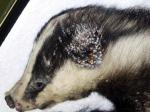
This is a wild Badger I was luck enough to photograph in South Essex. This group of badgers is photographed regularly so I was lucky enough to be able to sit outside with them, about 10m away. I did get badly midged though despite being complete covered from head to toe including a headnet.
Although it may not look like it this shot was taken at night. I used 4 flashguns so the badger is basically standing in a ring of light.
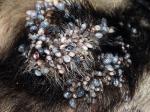
The sheep tick (Ixodes ricinus) & the hedgehog tick (Ixodes hexagonus) are members of the Arachnida family, having eight legs.
A few ticks will not normally cause any problem to an animal of badger size, but an infestation as concentrated as this could severely debilitate it. Firstly, a large number of ticks can cause anaemia, more of a problem in a smaller mammal such as a hedgehog. Infection can also develop, especially during the summer months, where ticks have pierced the skin with their mouthparts. They can also transmit other diseases to animals via the blood, & are the cause of Lyme disease in humans.
Ticks do not necessarily drop off once they have gorged themselves - the females will drop to the ground to lay several thousand eggs, but then she dies. They have a three year cycle, and although they may stay on their host for fairly long periods, the total number of days that they actually feed for is only around 30 days.
We remove ticks using tweezers - they come off fairly easily but care must be taken not to pull at the body but to take the tick off by the mouthparts to avoid leaving any of the tick in situ.